

“ChatGPT to kill search”, the headlines exclaim. No matter where you look, Chat GPT vs Google is at the top of search news everywhere. What does it all mean? Is it possible that Google, the search giant, has met its match?
Artificial Intelligence (AI) innovation is never a threat to Google. Google’s footprint in AI is well-known. Google’s origins in AI for search dates back to 2015. Google heavily employs AI in its algorithm and ranking engines. In the battle of the bots, Chat GPT vs Google is a foregone conclusion – Google wins.
The New York Times and several other news outlets have reported on the dire future of search due to the advent of Chat GPT and other chatbots leveraging artificial intelligence to answer searcher questions.
The news media’s reporting on the matter appears to want us to believe that this is a huge surprise to Google. It’s not. In fact, not only is Google aware of artificial intelligence and its potential impact on search, Google is the primary agent of AI in search.
Apparent insider reports and recordings claim Google has initiated “code red” regarding ChatGPT’s foray into the artificial intelligence space. But what is “code red” at Google? According to Barry Schwartz, a leading SEO news editor, back in 2012 – a “code red” at Google is a serious situation that requires “all hands on deck.”
In my work as an SEO specialist, one of the pillars of my success is content. I believe content is one of the three factors required to run a successful online business. I try hard not to be someone that uses absolutes when speaking about SEO. I believe SEO is fluid and it changes with each algorithm update.
I took some time to try out ChatGPT as well as a review of Google’s official policy and algorithm work regarding artificially generated content. Read on for the details of what I found.
Stack Overflow Bans ChatGPT Generated Answers
When considering Chat GPT vs Google, we must also look at other platforms as they relate to the use of Chat GPT. Stack Overflow is a popular community-driven site providing professional and hobby programmers with a platform to ask questions and receive answers from other developers.
Community members of Stack Overflow take the posts very seriously on the platform. They are definitely committed to providing not only accurate answers but the very best and most efficient answers. The platform supports a myriad of programming languages and topics.
Several outlets have reported that since the beginning of December 2022, Stack Overflow has banned answers generated using the popular chatbot. The reason behind this temporary ban is due to inaccuracy in the answers.
Stack Overflow’s blog provided a comprehensive statement on the matter citing that the answers from Chat GPT had a high rate of being incorrect. However, the real challenge is that while the answers were incorrect in many cases, they appeared to be genuinely correct making the user experience uneven and frustrating.
Stack Overflow’s blog states that the temporary ban will remain in place as they discuss and plan a formal policy over time. There is no specific timeframe mentioned as to when they will lift the ban or provide an official and permanent policy on the matter.
Moderators at Stack Overflow have said they are avoiding speaking publicly on how they are able to detect ChatGPT-generated content. They simply do not want to provide those leveraging ChatGPT with additional information that could be used to make the process of finding generated content more difficult.
Stack Overflow isn’t the only site to have banned ChatGPT and other chatbot activity. SEOPalooza recommends testing and results analysis when questioning new methods and approaches regarding SEO. When testing, it is important to protect your site from domain-wide Google manual actions. Manual actions from Google based on policy compliance can harm your site – sometimes irreparably.
Google Says AI-Generated Content Is Against Guidelines
Google has already made it a policy that artificially generated content is against its terms of service. John Mueller, long-time Google PR Engineer, has made this very clear. Sites determined to have used AI technology to produce content will be subject to Google’s manual actions. This will likely include being deranked. Some SEOs claim a site can actually be removed from the index in severe cases.
Google rolled out two algorithm changes this year on content. In August, and again in December 2022, Google rolled out their “Helpful Content Updates” which work to improve the quality of the content. Google remains vague on these updates, but generally, they provide some guidance in their Google Search Essentials document and other updates.
In their Helpful Content Update blog post, they provide the following guidelines:
- Content should be “people-first” focused
- Sites should have a primary intent or focus, niched
- Content should be informational and people should learn from it
- People should have a positive experience with your content
The guidelines also provide advice on avoiding a search engine-first approach. This is where you might write headlines and content that are designed to primarily attract search engines rather than humans.
The guidelines also warn against developing sites that discuss different and unrelated topics across a broad spectrum.
Google has made significant algorithm changes in 2022. In December alone there were several updates including enhancements to E-A-T (Expertise, Authority, and Trustworthiness), Helpful Content, and SPAM Links. Google added “Experience” to E-A-T, now known as E-E-A-T.
All of these updates contribute to the quality of the content being reviewed by the algorithm. It is important to SEO that you adhere to the guidelines or risk issues with being ranked well.
In my experience, unless your site has built up some authority and you have developed your content on long-tail keywords, it can take upwards of 6 to 8 months to see much activity in traffic.
Using a chatbot to generate content will still take time to get indexed if your site lacks authority and age.
It could be challenging to determine the cause when content fails to index or rank well in this case – is it because you are using AI-generated content, or is it because you lack authority on the site?
ChatGPT Detector
One of the key reasons I see no competitive threat to Google search on the horizon in terms of chatbots like Chat GPT is that there are powerful detection solutions in place. Google is a leader in AI technology. It has been incorporating AI in its various services and devices since 2015.
It might be naive to believe that Google doesn’t have the capability to discover chatbot-generated content. Again, Google is tight-lipped about its capabilities and algorithm when it comes to search and SEO.
ChatGPT was released to the public in late November 2022. It uses the latest AI model version (GPT-3) as its backbone. There are currently several methods and tools for determining AI content generated by previous versions of GPT.
Huggingface.co hosts a tool that can be used to assess content as real or fake. This particular tool is based on GPT-2. In my tests, I had mixed results. I copied text from a blog that had been created by ChatGPT, and this tool found it was more than 10% likely fake. This means it was 90% likely to have been created by a human.
In other tests I conducted, the tool was able to determine my content was AI generated with 99% certainty. I even reformatted and reworked the content to try and fool the results provided by the tool. This did nothing to help the results.
The work I had to do in order to reformat the content took me time to do – and it still failed the test after my work. The research in my tests appeared accurate, but I did find that ChatGPT repeated itself several times on key points. I had to remove some of the repeated sections to ensure a natural flow of the content. In doing so, this reduced the word count.
As the battle between Chat GPT vs Google heats up, I believe that this technology will improve and more tools will be available since Google and other prominent sites are banning the use of chatbot-generated content.
Google AI
One of the other key contributors to my belief that the Chat GPT vs Google battle will result in a big win for Google is that they have been in the Artificial Intelligence (AI) game for some time. In fact, they have several products and services based on AI. Google’s own RankBrain AI used to rank content in their search engine was introduced in 2015.
Google Assistant is another example of their artificial intelligence capabilities. In 2018 they demonstrated Google Duplex, a voice assistant designed to handle certain phone-based tasks for people such as restaurant reservations.
Though Duplex was sunset as part of their AI services, Google’s commitment to machine learning and artificial intelligence is as strong as ever with the new “code red” called from the executive level. This increases emphasis on an already elevated focus.
Google has a number of resources available for AI, machine learning, and various APIs including:
Google also has a large assortment of AI experiments that you can interact with. There are several experiment categories such as writing, art, music, and more.
To further paint the picture of Google’s AI capabilities, in July of 2022 a former Engineer at the search giant claimed that an AI project had become sentient. LaMDA (Language Model for Dialogue Applications) was a prototype AI introduced in 2021. LaMDA is an AI system capable of determining conversational intent. It likely rivals ChatGPT on a much more sophisticated level.
There is more to Google than meets the eye. LaMDA is a significant entry into the artificial intelligence space and it is clear that the “code red” is likely more about promoting the capabilities rather than establishing them.
The Psychology Of Search
Let’s take a look at the human psyche and think for a minute about how we search today.
More and more people are skeptical. We are skeptical of our leaders. We are skeptical of our media. We are skeptical of each other. We are all guilty of fish stories. We all feel the need to embellish to get a point across. This has led to our questioning of what we are told to be true.
We search in much the same manner. We question everything and we are looking for specific information – and we are looking for accurate information. In doing so we seek evidence that the publisher of the content we are looking at, actually has experience or expertise in the topic.
This is why E-E-A-T (Experience, Expertise, Authoritativeness, and Trustworthiness) are a factor in Google’s algorithm. I believe it is a significant factor. Google knows what is important to us when we are searching.
Have you ever looked at a bounce rate in Google Analytics – pick any site. Most are in the range of 80% or higher. Why? It’s not because the information is bad or wrong or not relevant or incomplete, in most cases.
Instead, it’s because the searcher wants to find additional content elsewhere that backs up the information being provided. They want a second opinion.
On some of my most successful SEO projects, there is a common pattern with those that end up buying from these sites. They don’t tend to buy on the first visit.
We see data that shows they leave and come back to our sites before they buy. Many do this at least once, many do this multiple times.
Oh, there are SEOs that will challenge this and say, “You aren’t educating them enough” or, “You haven’t monetized well” or “You need a better conversion strategy” – All of these are accurate and true – many sites could benefit from improvement on all of these things.
However, even with these being perfect it would not change how people search – today’s searchers have the desire to find multiple sources in order to formulate a decision they are comfortable with.
The Chat GPT vs Google Search outcome relies on the searcher and their trust factor in a single response.
Tips On Using Chat GPT For SEO
I don’t recommend using Chat GPT to write your content, but I do believe it has value for use with SEO. In fact, I don’t believe in using any AI generator for content. This would include Surfer SEO, PostPace, Closer, Frase, or any other tool that dynamically creates content.
I am a member of Matt Diggity’s Affiliate Lab. The Affiliate Lab is a membership site that requires a one-time payment of $997. Matt’s program is one that I recommend, but it is full of “black hat” advice and some of the information is counter to what I teach here. There is some risk in what Diggity teaches. I recommend you review SEOPalooza to find advice and guidance on how to best use Diggity’s training in a “white hat” approach.
Matt also has a free YouTube channel where he provides SEO tips. His latest video is all about Chat GPT. He gives his opinion on how the tool impacts Google search. He also gives some tips on how to leverage Chat GPT for use with your SEO work. Some of this advice is excellent and I’ve tested it briefly.
I would be comfortable using Chat GPT for SEO in the following ways:
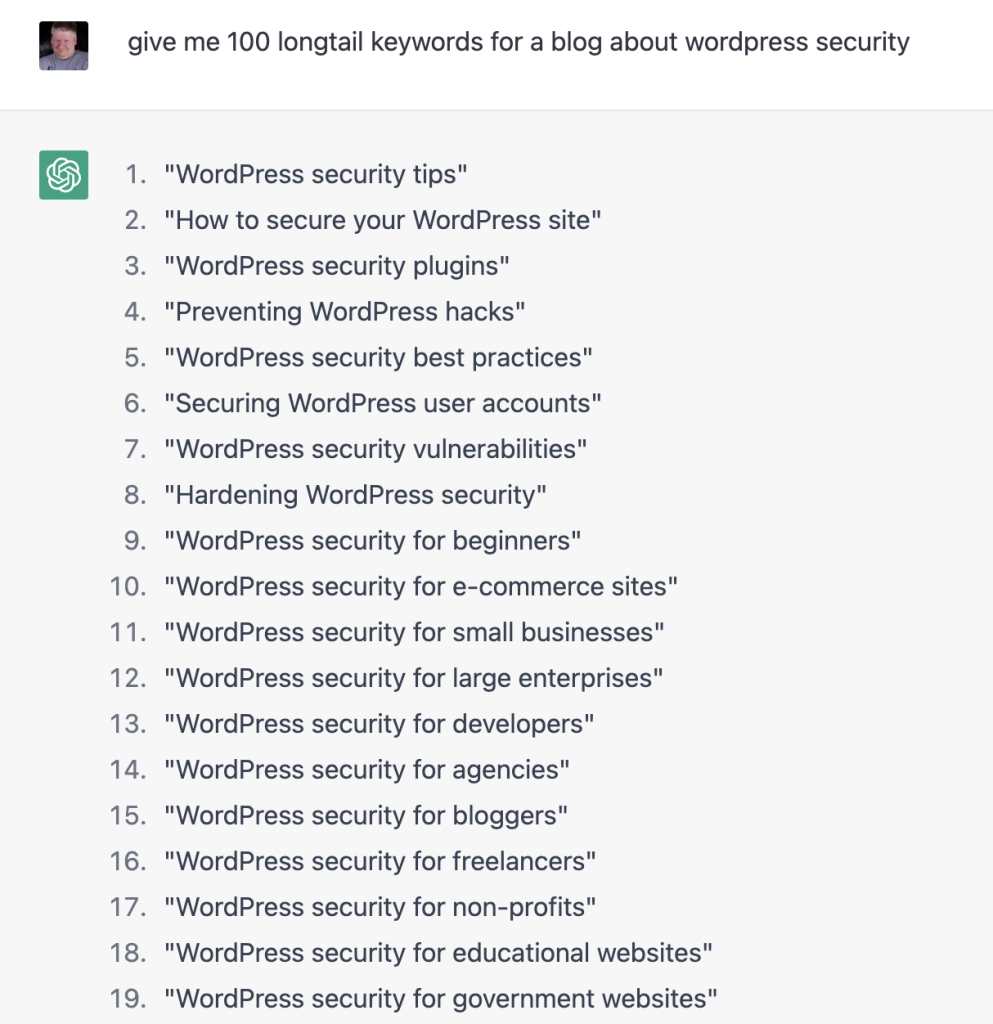
- Ask Chat GPT to provide long-tail keywords on a niche or topic
- Example, “give me 100 longtail keywords for a blog about wordpress security”
- Refine your keyword query using something like this:
- Example, “what are some easy longtail wordpress security keywords to target on my blog”
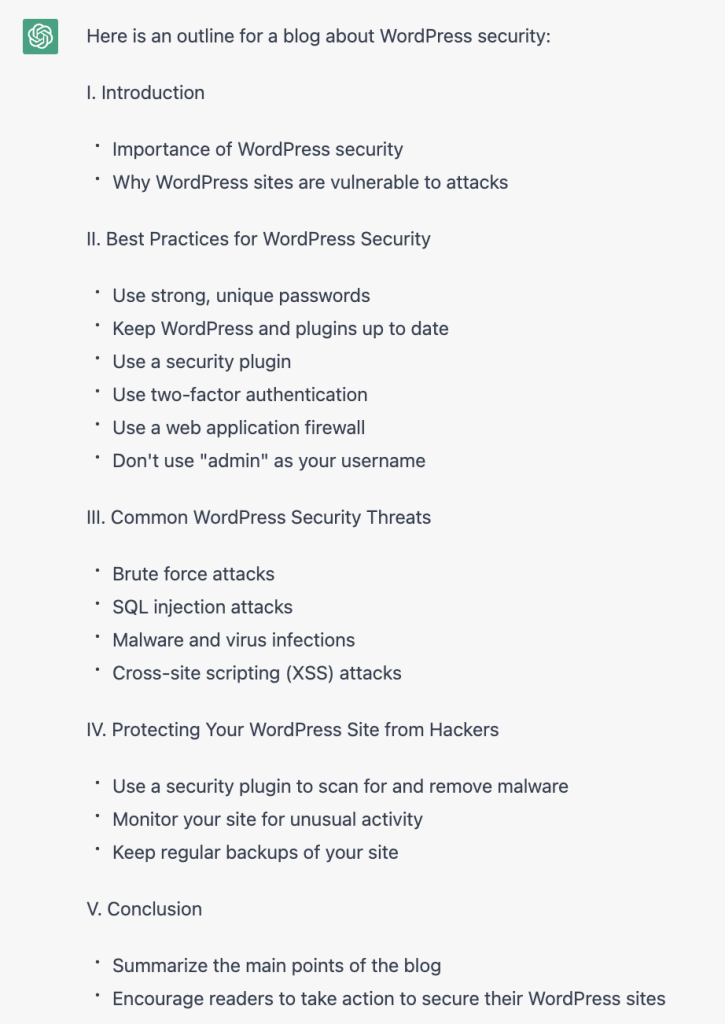
- Ask Chat GPT to provide a blog outline
- Example, “give me an outline for a blog about wordpress security”
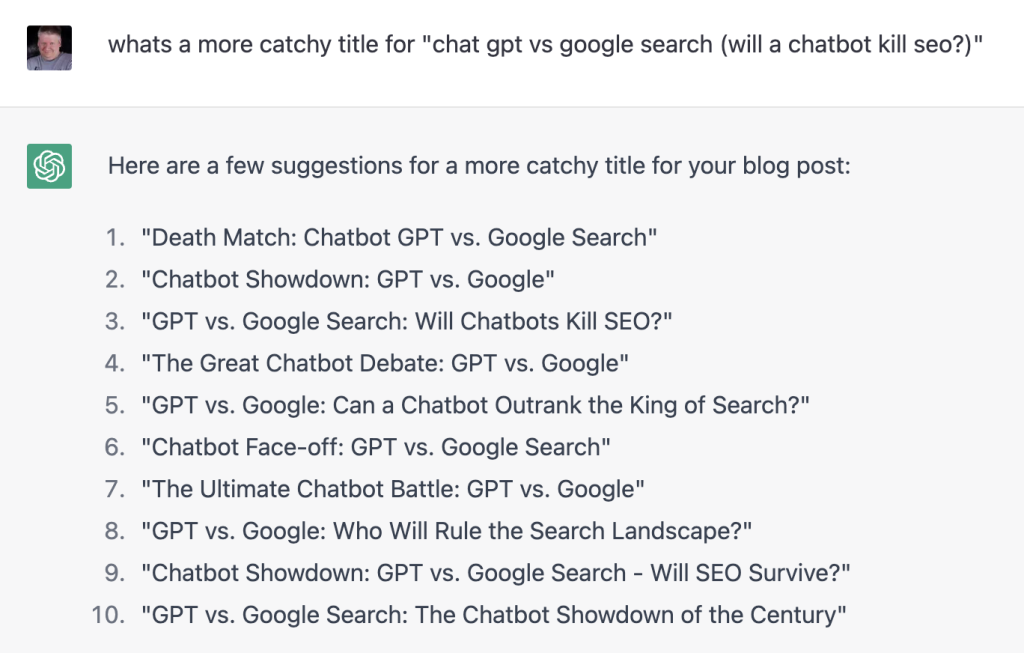
- Ask Chat GPT for a more influential title
- Example, “whats a more catchy title for ‘chat gpt vs google search (will a chatbot kill seo?)'”
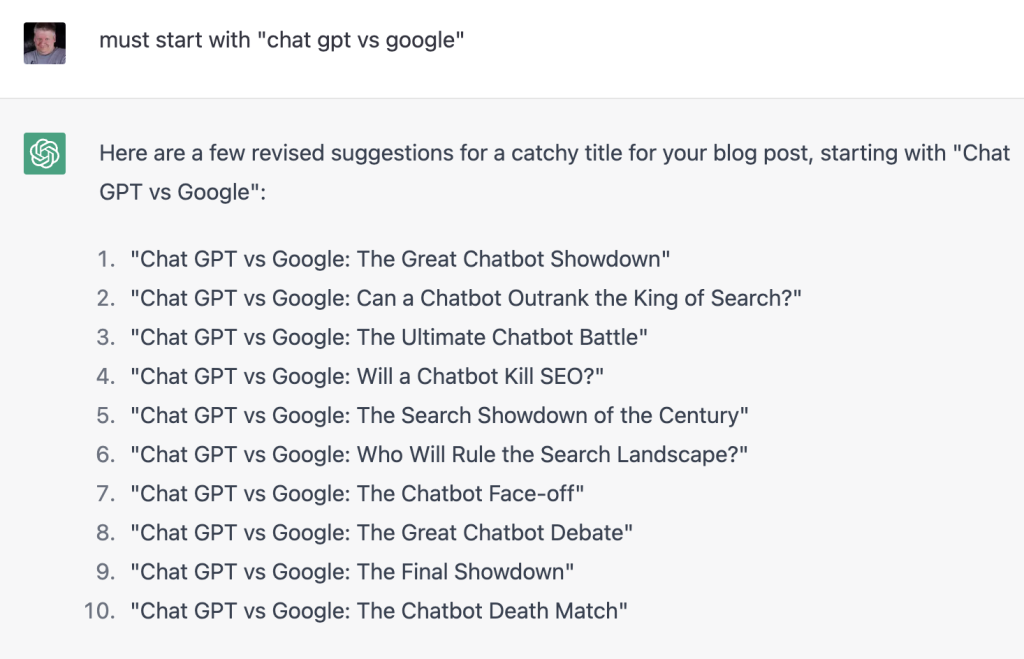
- You can further refine the title it provides by telling Chat GPT that you want the title to start with your primary keyword like, “must start with ‘chat gpt vs google'”
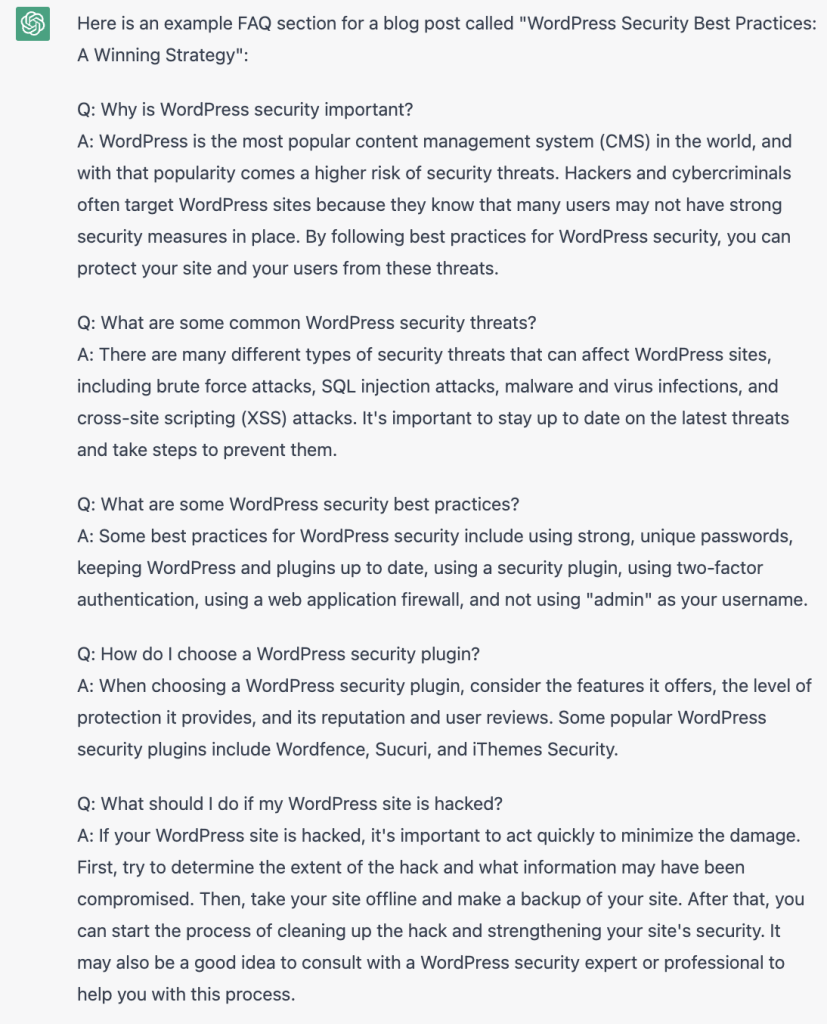
- Ask Chat GPT to create an FAQ section for your blog
- Example, “make an faq section for a blog post called ‘wordpress security best practices (A winning strategy)'”
I also like the suggestion Matt makes about asking Chat GPT what semantically relevant topics are missing from a post. In the example, he pastes a blog into Chat GPT along with the query. This could be useful in ensuring you have covered as much as possible.
A word of warning, however, I would not be comfortable allowing Chat GPT to provide specific text to use in my post. I would also highly recommend that if you ask the tool for a list of long-tail keywords, you look these up manually for search volume. You want to ensure the search volume is within your desired parameters. We would look for volumes of 10 to 110 in most cases.
When we asked Chat GPT for a list of 100 long-tail keywords pertaining to WordPress Security, it gave us 70. I don’t see this as a problem, but be aware it will only give you what it can find.
We asked Chat GPT to give us an outline for our article. It did an ok job, but again, I would be very careful to ensure that the topics in the outline have search volume. I do like the suggested organization of the content provided by the tool.
I was encouraged when I asked Chat GPT to provide me with a title for my blog. It gave me a nice list to consider. I would run these through the headline analyzer to ensure the pixel width of the title and character count. These are critical for influencing clicks from Google Search Results.
I then asked the tool to refine the titles by ensuring they began with my primary keyword. The result was pretty good, but again, I’d run these through the Headline Analyzer to ensure they comply with the pixel width and character count.
Finally, I asked the Chat GPT tool to provide me with an FAQ section for a blog post about WordPress Security Best Practices. I feel it did a pretty good job. However, there needs to be caution exercised because I am concerned about duplicate content. I have not done enough research to see if this might be an issue, so it is something I will be keeping an eye out for. I wonder if asked the same question from several SEO analysts if the responses will be similar – in this case, it would mean two competing websites would have the same exact content. This could be detrimental to one or both sites.
ChatGPT vs Google Search: Who Wins?
I spent 4 hours researching and writing this article. ChatGPT was able to pump out 400+ words (less than 500 each time) for me in seconds. Yet, I found myself having to rework the formatting, the duplicate sections, and much of the grammar.
I did not see a problem with the accuracy of the topic, however, I did notice an inability to go very deep into the comprehensive nature of the topics I chose. This could be simply due to my queries.
I believe that if I spent more time refining my queries I may get better results.
However, the point of using AI to help with SEO content generation is to save time in producing a lot of content very quickly in order to leap to the top of the search results. I suspect I would be spending as much time (or even more) working with the chatbot to get the quality I would need.
One important point to mention is that when I conducted my tests, and in my research of others who used Chat GPT to generate content, the bot generally created less than 500 words. This could likely be solved by running each of your headings in your post outline individually through the bot. You should have 300 words for each heading anyway, so this might work. I have seen evidence of others being able to get 1,000 words or more out of Chat GPT, so it is definitely my lack of understanding of how to craft an effective query.
I believe that ChatGPT is a great demonstration of what artificial intelligence is capable of. However, based on how we use search and how much we distrust single-source information, I do not believe there is a threat to SEOs, bloggers, or others relying on Google search as a business.
I also believe that ChatGPT is not as sophisticated as LaMDA and other projects Google is working on. Google has a lot in its toolbox in order to continue its dominance for years to come.
Searchers need Google to find answers to their needs. Whether it be an interest, a problem, or a whim – searchers need Google. Google needs publishers and content creators – without them, Google is only an empty vessel – Google is the car with no gas. The gas that fuels Google are the publishers.
Much the same is likely for chatbots. Their fuel, too, is the vast number of publishers and content they create. Without them, they are nothing.
I believe Google has the ability to create an enormous database of information from which to cut out all the publishers and provide direct answers. Yet, it comes down to a few unknowns. Where did Google get the information? Who owns the information? What would Google, publishers, and the world gain from single-source answers by Google? Why hasn’t Google already done this if it’s the right idea?
The facts are simply that the public is much less trusting of single-source information. We like to investigate for ourselves to ensure the information isn’t biased or supporting some agenda. We want multiple answers to review in order to make an informed decision with accuracy.
Google isn’t going away because of a chatbot. Google wins the Chat GPT vs Google Search battle.
I hope this post provides you with more ideas to consider in the Chat GPT vs Google search debate. I don’t believe Chat GPT will impact the future of SEO. If you have thoughts or questions about this post or how to use Chat GPT effectively for SEO, hit me up in the comments.